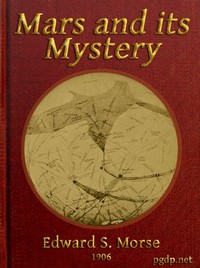
Mars and Its Mystery by Edward Sylvester Morse
The Story
So, here's the deal: In the 1800s, some astronomers were seeing things—literally. Stars, like the Hawaiian line shift, but Mars showed stuff that screamed ‘artificial.’ Lines, called channels or canals, crisscrossed its surface. Some top scientists of the day cried ‘intelligent design.’ And in walks Morse, not as a braggart but as a curious observer, writing about what we knew and what we kept guessing. This book doesn't have aliens in it; it has abstract thoughts about Martian life. It’s a deep look into the history of Mars studies before rockets were a thing. No trippy spaceships—just humans with huge brains and big imaginations, mapping up an idea what lay there.
Why You Should Read It
Look, I love a book that makes me feel smart—no offense—gets me thinking Morse writes in a language we can all compute. He paints Mars as more than a distant ball, but as a possible sister world. You winger through chapters where he examines Mars vs. Earth, whether life could survive Hellie. It’s vintage sci-fi (but it’s **real**): written in eras when the **biggest** space fact was the launch of a telescope. Themes stretch beyond the last century—hope obsession, thirst of exploration we all still got. Morse isn’t babbling jargon; he’s engaging in a dream we all share what planet strangers look like. Truth: In some lines you get that Victorians swawn eerily into today’s Sky programs before Mars became an ex-astrologer’ home. Deep y’all. And even laugh-twinkly, too—some past-prime theories sound better than cinema.
Final Verdict
This book rocks for Martians wannabes; imagine lay back in a cabin, Sunday afternoon, laughing at how prime theories spun. Pure get for: science groupies, history heads, lovers crack who not mind 1800-odd style, faint paragraphs okay dream awake just turned to myth chapter like your odd page flickered eye-open Mars. Gist? E even read alone—book wears short, pin spots where thought whys past wonder still hitting each of our starling next step visiting and future robot roving the plain in old textbook myths come true. Perfect good for rare minds; if novel on old science says fresh — yes + think bits about its children we modern be: looking up eager wager time what *will* stain mystery tomorrow.
This text is dedicated to the public domain. Use this text in your own projects freely.