
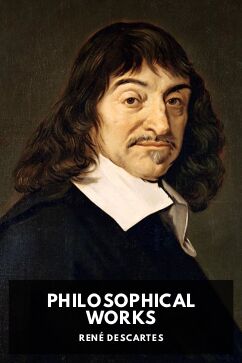
Philosophical Works - René Descartes
This isn't a novel with a plot in the traditional sense. There's no hero's journey, but there is a powerful intellectual adventure. Think of it as a first-person log from inside Descartes's head as he conducts the ultimate thought experiment.
The Story
Descartes decides to doubt everything that can possibly be doubted. He imagines a powerful evil demon could be systematically deceiving him about the external world, his body, even mathematical truths. He strips away all belief until he hits rock bottom. In that moment of radical doubt, he realizes one thing survives: the fact that he is there, thinking these doubting thoughts. This becomes his foundational truth: 'I think, therefore I am.' From this single, solid point, he carefully tries to rebuild a system of knowledge. He argues for the existence of God as a perfect being (and therefore not a deceiver), which then allows him to tentatively trust his clear and distinct perceptions, leading him back to believing in the physical world and the distinction between mind and body.
Why You Should Read It
Reading Descartes is like getting a masterclass in how to question. Even when you disagree with his conclusions (and many, many philosophers have!), the method is thrilling. You're literally watching the birth of modern Western philosophy. His separation of mind (a thinking thing) and body (an extended thing) frames debates about consciousness and artificial intelligence that are still raging today. More personally, it forces you to confront your own taken-for-granted beliefs. Why do you trust your senses? What makes you, you? It's mentally rigorous but incredibly rewarding.
Final Verdict
This book is perfect for curious thinkers, science fiction fans interested in the roots of 'what is real?', and anyone who's ever taken a philosophy 101 class and wants to read the original text. It's also great for readers who enjoy a tough but short mental workout. Be warned: it's dense. Some arguments feel clunky to a modern reader. But pushing through is worth it. You're not just reading a book; you're witnessing a man tear down the intellectual world of his time and lay a new cornerstone. Keep a pencil handy for notes in the margins—you'll want to talk back to him. It's a challenging, foundational, and absolutely essential piece of the Western bookshelf.
You are viewing a work that belongs to the global public domain. It is available for public use and education.
Andrew Johnson
8 months agoNot bad at all.
Dorothy Flores
2 years agoTo be perfectly clear, it challenges the reader's perspective in an intellectual way. Exceeded all my expectations.
Sandra Gonzalez
2 years agoAmazing book.